Welcome to pg_mooncake
pg_mooncake is a PostgreSQL extension that adds real-time columnstore mirror tables (USING mooncake), DuckDB 2.0 vectorized analytical execution (via pg_duckdb and duckdb_mooncake), and open Apache Iceberg v2 storage (powered by moonlink) directly inside PostgreSQL.
PostgreSQL with pg_mooncake ranks among the fastest analytical databases on ClickBench while keeping your existing PostgreSQL transactional write path untouched. Originally created by Mooncake Labs, the extension suite (pg_mooncake v0.3.0, duckdb_mooncake v0.0.2, and moonlink v0.0.1) is now maintained by the PGSTY community for PostgreSQL 14–18.
v0.3.0)pgsty/pg_mooncake(v0.3.0,MIT): PostgreSQL extension providing theUSING mooncaketable access method,mooncake.*SQL procedures, and the embedded Moonlink background worker (pgrx 0.19.3).pgsty/moonlink(v0.0.1,BSL-1.1withpg_mooncakeLinking Exception): Real-time Rust storage engine that ingests PostgreSQL logical replication streams into in-memory Arrow buffers, Roaring Bitmap deletion vectors, and Apache Iceberg v2 / Parquet files.pgsty/duckdb_mooncake(v0.0.2,MIT): DuckDB 2.0 storage extension bundled withpg_mooncakethat scans Moonlink tables with multi-file Parquet statistics pruning.
The Problem
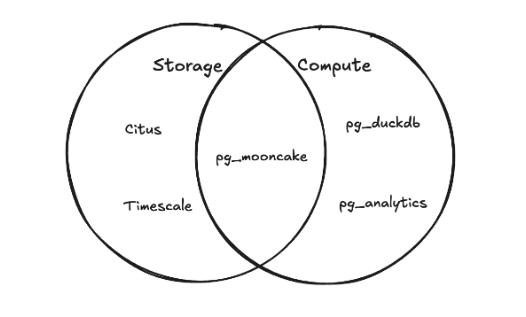
PostgreSQL is an exceptional transactional (OLTP) database, but its row-oriented heap storage and tuple-at-a-time executor are not designed for large-scale analytical scans (OLAP). Historically, PostgreSQL teams faced two flawed choices:
- Adopt a separate analytical system (ClickHouse, Snowflake, BigQuery) Requires maintaining fragile CDC pipelines (Debezium + Kafka), duplicating data models, dealing with eventual consistency lag, and losing the ability to join live operational tables with analytical history in a single query.
- Use in-database columnstores without vectorized execution or real-time CDC
Traditional columnar extensions either lack a modern vectorized execution engine or cannot handle high-frequency transactional
INSERT,UPDATE, andDELETEoperations without generating thousands of tiny Parquet files.
How pg_mooncake Solves It
Starting in v0.2 and refined in PGSTY’s v0.3.0 release, pg_mooncake introduces a columnstore mirror architecture:
- Write to Rowstore, Read from Columnstore: Your application continues writing (
INSERT,UPDATE,DELETE) to the standard PostgreSQLtradesheap table with full ACID guarantees and indexes. - Sub-Second Logical Replication via Moonlink: Behind the scenes,
pg_mooncake’s background worker streams WAL changes intomoonlink, buffering recent mutations in memory as Apache Arrow batches and tracking updates/deletes via Roaring Bitmap deletion vectors before compacting into Parquet files. - Vectorized DuckDB 2.0 Queries: Analytical queries against
trades_analyticsare routed throughpg_duckdb 1.2.0andduckdb_mooncake v0.0.2, merging in-memory Arrow buffers and on-disk Parquet segments with segment elimination and LSN consistency barriers. - Open Apache Iceberg v2 Lakehouse: With
CALL mooncake.create_snapshot('trades_analytics'), Moonlink emits standard Apache Iceberg v2 metadata on local disk, AWS S3, or Cloudflare R2—ready for Spark, Snowflake, DuckDB, or PyIceberg without any ETL pipeline.
Explore This Section
Understand how pg_mooncake, pg_duckdb, duckdb_mooncake, and moonlink coordinate writes, reads, and Iceberg snapshots.
Deep dive into Moonlink (v0.0.1), in-memory Arrow write buffers, deletion vectors, and standalone HTTP/RPC server deployment.
Learn how duckdb_mooncake v0.0.2 integrates with DuckDB 2.0 and pg_duckdb 1.2.0 for vectorized scans and Parquet statistics pruning.
Compare the legacy v0.1 Delta Lake (USING columnstore) architecture with v0.2 Moonlink mirrors and PGSTY’s v0.3.0 enhancements.
How pg_mooncake (v0.3.0), pg_duckdb (1.2.0), duckdb_mooncake (v0.0.2), and moonlink (v0.0.1) work together to deliver real-time columnar analytics in PostgreSQL.
Deep dive into Moonlink (v0.0.1): real-time CDC ingestion, Arrow buffers, Roaring deletion vectors, LSN snapshot barriers, and standalone HTTP/RPC deployment.
How duckdb_mooncake (v0.0.2) connects DuckDB 2.0 and pg_duckdb 1.2.0 to Moonlink tables, performs multi-file Parquet statistics pruning, and installs via a local extension repository.
Architectural comparison between pg_mooncake v0.1 (USING columnstore + Delta Lake), v0.2 (USING mooncake + Moonlink + Iceberg), and PGSTY’s v0.3.0 release.